Oct 01, 2026
0 comments
Starting counselling can feel daunting, especially if you are not quite sure what is wrong. You just know that something needs to change.
You may be feeling anxious, emotionally exhausted, stuck in the same patterns, disconnected from yourself, overwhelmed by your thoughts, or carrying experiences from the past that still seem to affect you today.
You do not need to arrive with everything figured out.
Holistic counselling gives you a space to slow down, make sense of what you are experiencing and begin looking beneath the surface, not only at the symptoms you are dealing with, but at what may be contributing to them.
Step 1: We Start With What Is Happening for You Now
Your first session begins with a conversation.
There is no pressure to tell your entire life story or know exactly where to begin.
We can explore what has brought you to counselling, how you have been feeling lately, what feels difficult right now and anything you feel may be connected to it.
This helps me understand not only what you are experiencing, but also the bigger picture around it.
From there, we can begin identifying which therapeutic pathway may suit you.
Step 2: We Get Clear on What You Want to Change
For some people, the goal is obvious.
They may want to reduce anxiety, process trauma, work through grief, improve their relationships or feel more confident.
For others, it may simply be:
“I don’t feel like myself anymore.”
You might want to stop overthinking.
Feel calmer in your body.
Understand why you keep repeating the same patterns.
Feel more present in your relationships.
Release emotional weight from the past.
Or reconnect with the part of you that has been buried underneath stress, responsibility or survival mode.
Your goals become the starting point for a therapeutic approach that is shaped around you, rather than expecting you to fit into one particular method.
Step 3: We Look at What May Be Underneath the Problem
Holistic counselling goes beyond simply asking, “How do we manage this symptom?”
We also explore:
Why might this be happening?
Anxiety may be connected to long-term stress, past experiences, learned beliefs or a nervous system that has become used to staying on alert.
People-pleasing may be connected to earlier experiences of needing to keep the peace.
Exhaustion may not only be about how much you are doing, but how difficult it feels to mentally and emotionally switch off.
Feeling disconnected may have developed gradually after years of putting everyone else’s needs before your own.
This is where holistic healing services can offer a broader perspective.
Rather than treating the mind, body and emotions as completely separate, we look at how they may be influencing one another.
Step 4: We Use the Tools That Suit You
There is no one-size-fits-all session.
Depending on what you need, your counselling may incorporate different evidence-informed, trauma-informed and holistic tools.
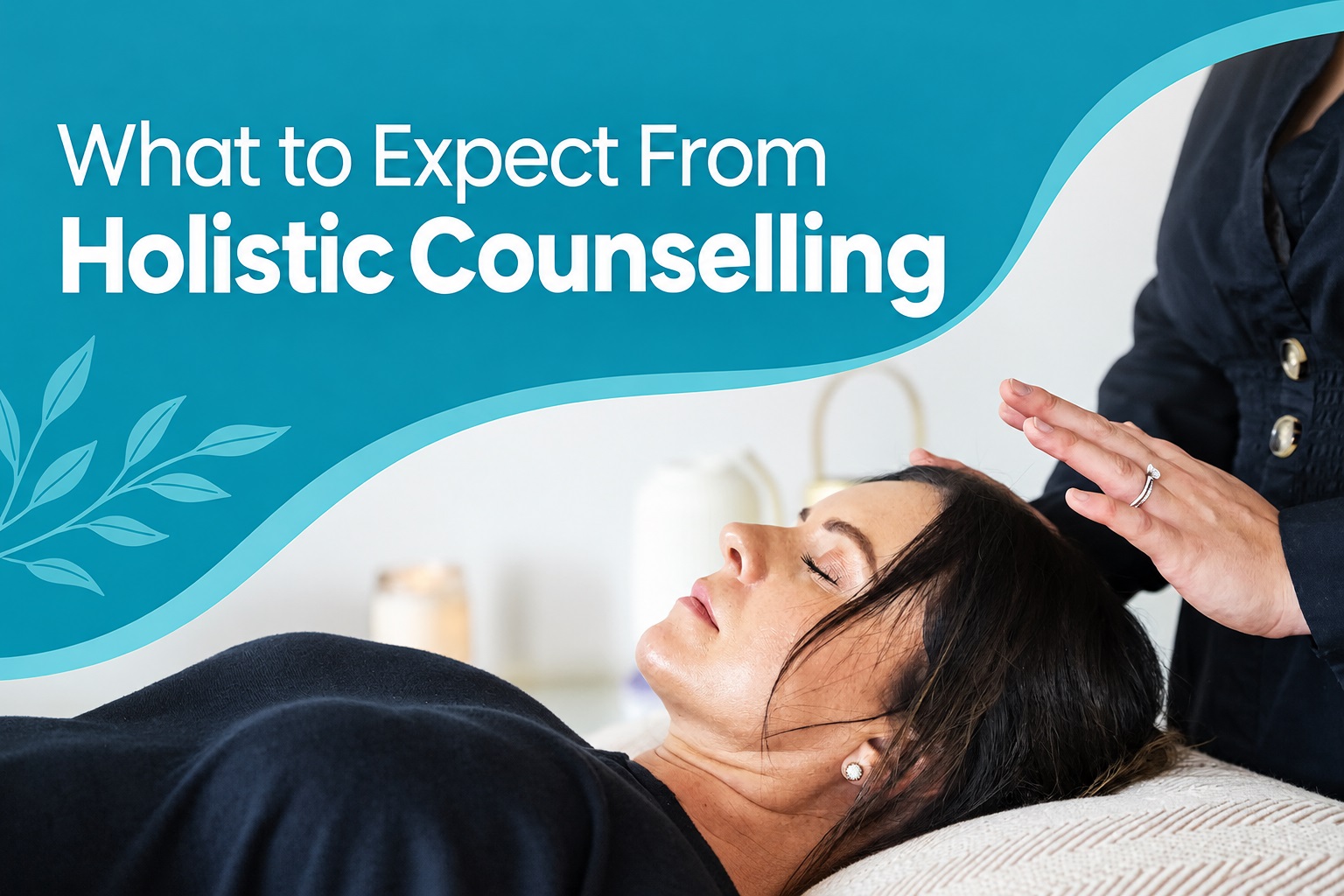
This can include counselling, mindfulness, nervous system regulation, somatic practices, trauma-focused techniques, neuroscience-based strategies, health coaching or energy-based approaches such as Reiki healing.
You will not automatically receive every modality.
The purpose is not to overwhelm you with techniques.
It is to choose the approaches that are most relevant to what you are experiencing and where you want to go.
Step 5: You Begin Understanding Your Patterns Differently
One of the biggest shifts can happen when something you have struggled with for years suddenly starts to make sense.
You may begin noticing why certain situations trigger such a strong emotional response.
Why you find it difficult to rest.
Why you automatically put other people first.
Why your mind jumps to the worst-case scenario.
Why certain relationships affect you so deeply.
Or why you can appear completely capable on the outside while feeling overwhelmed internally.
Greater self-awareness gives you the opportunity to respond differently instead of automatically repeating patterns that may have been operating for years.
And importantly, understanding the pattern is only one part of the work.
We can also begin helping your mind and body learn a different response.
Step 6: You Begin Moving Forward, Not Staying Stuck in the Story
Holistic counselling is not about repeatedly talking about the past for months or years without creating change.
Your past may be explored when it helps us understand what is happening in the present, but the intention is not to keep you living there.
Once we understand the pattern, we can begin working with the parts of you that may still be carrying it.
That may include your thoughts and beliefs, emotional responses, nervous system, physical stress patterns or the way certain experiences are still being held within the body.
This whole-self approach can help you move beyond simply understanding why you feel the way you do and begin creating a different experience in your day-to-day life.
Over time, the past can become something you understand rather than something that continues to control how you feel, react or relate to yourself.
The focus gradually becomes less about what happened and more about who you are becoming now.
Step 7: You Leave With Something You Can Take Into Your Life
Therapy does not have to end with you simply talking for an hour and then returning to exactly the same patterns.
Depending on the session, you may leave with a new understanding, a practical strategy, a nervous system tool, a different perspective or something to practise between appointments.
Sometimes the shift is significant.
Other times it is subtle.
You may notice you respond differently to something that would normally trigger you.
You feel calmer in a conversation.
You catch an old pattern earlier.
You set a boundary without as much guilt.
You sleep a little more deeply.
Or you simply feel more connected to yourself again.
These small changes can build into much bigger ones over time.
Holistic Counselling Is About More Than Coping
If you have been living with anxiety, emotional exhaustion, self-doubt, unresolved experiences, relationship difficulties or the feeling that you are constantly “on”, you may not need another strategy for pushing through.
You may need the space to understand what is happening underneath it.
My approach brings together holistic counselling, trauma-informed therapy and whole-self healing to help you work with the mind, body, emotions, nervous system and deeper patterns that can keep you feeling stuck.
The goal is not to change who you are.
It is to help you release what has been weighing you down, understand yourself more deeply and create more space for calm, connection, energy and the feeling of being yourself again.
 CONTACT
 Frequently Asked Questions
Q: What actually happens during a holistic counselling session?
A holistic counselling session is centred around what you are currently experiencing and what you would like to change.
We may explore your emotions, thoughts, relationships, stress levels, past experiences, habits, physical wellbeing and the patterns that may be influencing how you feel today.
From there, I tailor the session to you.
Some sessions may involve deeper counselling and self-reflection, while others may include practical nervous system tools, somatic techniques, mindfulness, trauma-focused approaches, neuroscience-based strategies or other holistic therapies.
The aim is not to follow a rigid formula.
It is to understand the whole picture and use the approaches that are most relevant to you.
Q: Will holistic counselling include meditation, Reiki or other holistic practices?
It can, but it does not have to.
Holistic counselling may incorporate mindfulness, meditation, somatic practices, nervous system regulation, health coaching, trauma-focused support or energy-based therapies such as Reiki.
These are not automatically used in every session.
What we use depends on your individual needs, preferences, comfort level and therapeutic goals.
Some people respond well to talking and practical strategies.
Others find that combining counselling with body-based or energy-based work helps them access things that are difficult to shift through talking alone.
The approach is always personalised.